
Dear reader, I hope you had a happy New Year and holidays. I hope you had a good time and that you didn’t eat or drink too much. As for me, I did both, but I am hoping that you were more reasonable than I.
In this crazy time, I think that this subject is right the subject being looking into the mirror. What does that mean in reality? It means: what do you actually see when you look into the mirror? To some, this may seem banal and insignificant, but to others, it may raise blood pressure a little or a lot.
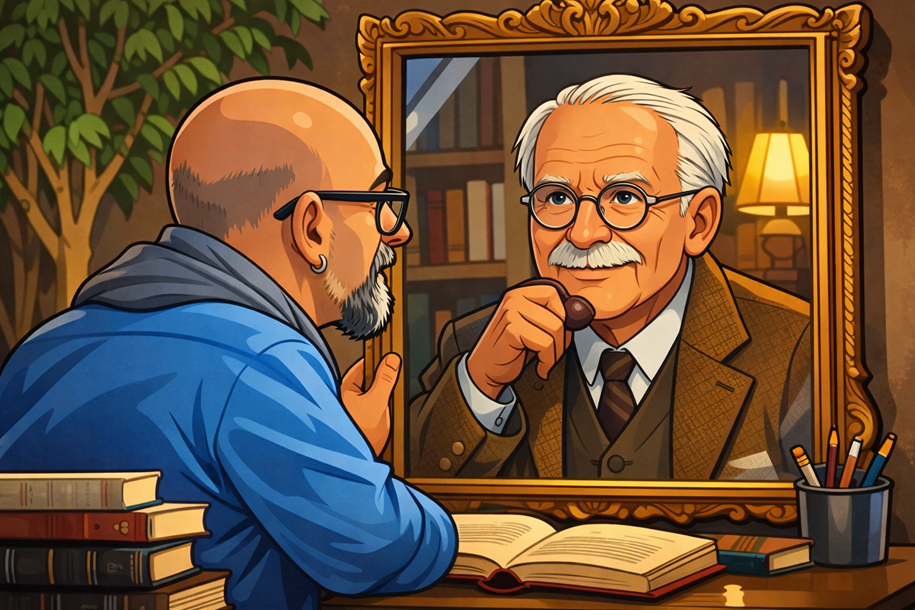
What do I mean by this? I’ll explain according to Jung. When we look in the mirror, we may be seeing:
- our Persona (who we try to be),
- our Shadow (what we avoid),
- our Ego (who we think we are),
- our Anima/Animus (inner psychic balance),
- and, ideally, moving toward the Self (integration and wholeness).
Let’s explain these a little better,
The Persona, the Mask we Present to the World
The first thing we usually recognize is our Persona:
our social identity, roles, and image, we want others to accept. That which we wish others to see, and sometimes we wish ourselves to believe the same, the face we want everyone, and sometimes even ourselves to see. Here are some examples.
- “Do I look confident enough?”
- “Do I look how I should look?”
- “Does this reflect who I want others to think I am?”
In the mirror, many people unconsciously check whether their reflection matches their expected identity (professional, attractive, strong, composed, “normal”). But what looks normal to us doesn’t mean it’s normal to others. I have noticed that people cling to religion and pretend that they are religious, and just by the fact that they go to church or mosque or temple that in itself makes them good people, but never for a second do they stop and think, how I am in my immediate family, am I the best version of my self, am I the best that I can be, this type of people are in a wrong state of mind and if they are truly believers then they should know that.
The Shadow: the parts we don’t want to see.
Beneath the Persona lives the Shadow: the repressed, unwanted, or feared parts of ourselves. Jung did not see the Shadow as evil; he saw it as unlived life, everything that did not fit the image we learned to present to the world. The more polished the Persona, the darker and more crowded the Shadow often becomes.
The mirror can trigger:
- insecurities
- guilt or shame
- traits we deny (“I’m not like that”)
- emotions we suppress
What we reject does not disappear; it waits. It shows up in projections, sudden emotional reactions, judgments of others, and moments when we surprise ourselves. Very often, what disturbs us in others is something we have not yet made peace with in ourselves.
Sometimes, discomfort with one’s reflection is less about appearance and more about encountering a self we are afraid to acknowledge. The mirror does not lie; it simply reflects what consciousness has not yet integrated. To look away is easier, but to look honestly is the beginning of individuation.
In a class I attended with Prof. Žarko Trebješanin, I defined the Shadow as “the person we hide even from ourselves and don’t want to face or disclose.” I still stand by that. But I would add this: the Shadow is not an enemy. It is a teacher, rough and uninvited, asking only one thing, to be seen.

The Ego: the conscious “I”
The Ego is the part that says:
“That’s me.”
It is the center of our conscious awareness, the part that helps us recognize ourselves as a continuous identity. It tries to maintain stability between the Persona and the Shadow, balancing what we show the world and what we hide from it. The Ego seeks order, coherence, and a sense of control over who we believe we are.
When the reflection does not fit who we think we are, tension or self-criticism may appear. This is why mirrors can challenge identity. The mirror does not simply reflect appearance; it can reflect the gap between the self we believe we are and the self that quietly exists beneath awareness.
Sometimes the Ego defends itself by rejecting or explaining away what feels unfamiliar or uncomfortable. Yet, according to Jung, growth begins precisely in those moments when the Ego is willing to question its certainty and allow new parts of the self to emerge into consciousness.
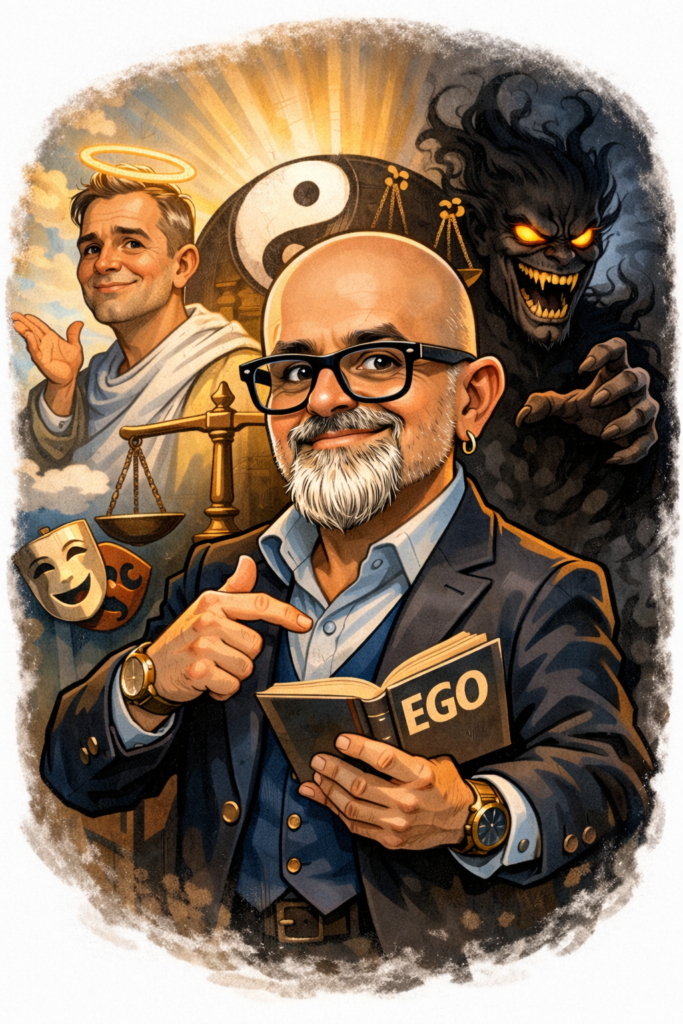
Anima/Animus: the inner gendered psyche
For Jung, every man carries an inner feminine dimension (Anima), and every woman carries an inner masculine dimension (Animus). These are not simply traits of gender, but psychological energies that shape how we relate to emotions, relationships, and inner balance.
Sometimes, when looking in the mirror, people unconsciously evaluate:
- gentleness vs. strength
- softness vs. firmness
- emotional vs. rational presence
The mirror can stir deeper emotional reactions or symbolic self-questioning. It may not be about appearance at all, but about recognizing qualities within ourselves that we have accepted, rejected, or simply not yet understood.
I believe that each of us carries feminine traits, just as every woman carries masculine traits. These elements are not contradictions; they are parts of psychological wholeness. When one side is denied or suppressed, imbalance often appears, but when both are acknowledged, a deeper sense of integration can emerge.
The Self, Wholeness, and Integration
At deeper psychological maturity, the mirror becomes a place of acceptance, not judgment.
Seeing oneself means facing:
- flaws + strengths
- light + shadow
- social self + authentic self
This movement toward embracing all parts of the psyche is Jung’s process of individuation, becoming whole. The Self, I would compare to Maslow’s Hierarchy of Needs, the last step of the pyramid, or the fifth one, which is self-actualization: becoming what you are capable of, pursuing personal growth, meaning, creativity, and fulfilling potential.
I would add reaching your full potential and becoming the best version of yourself. I actually teach this and how one can become the best version of themselves, so come to one of my classes in the future.
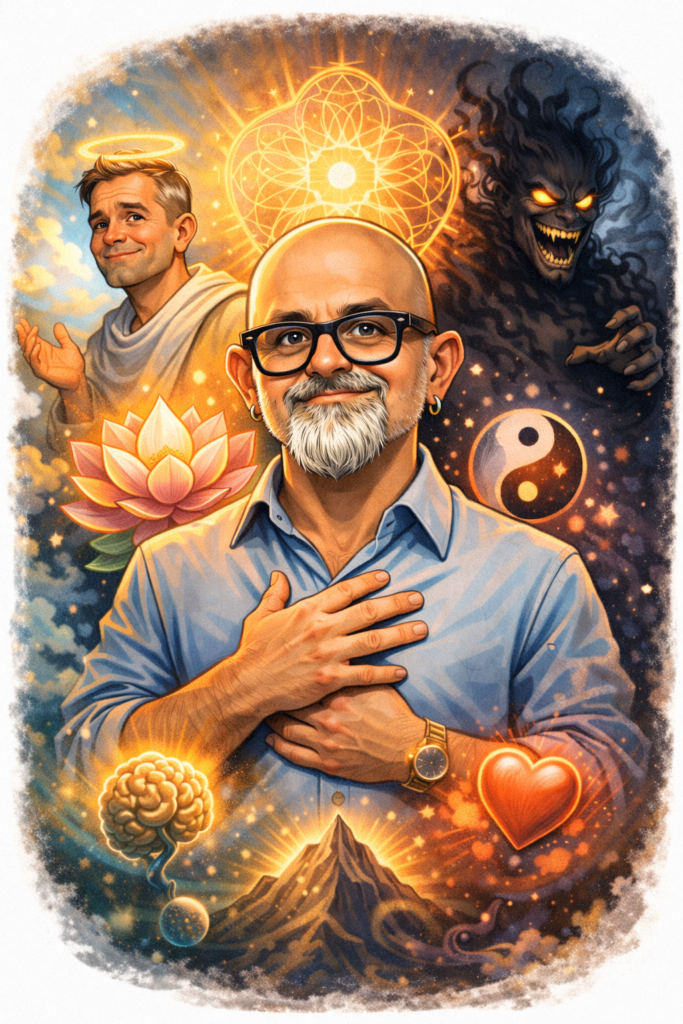
In a newer, or final, version, there is one more level called self-transcendence, which means serving something beyond the self-values, spirituality, and community. Simply said, self-transcendence is going beyond your own needs and ego to serve a larger purpose, such as helping others, living your values, or contributing to something greater than yourself.
Do you, my dear reader, look into the mirror and ask yourself, AM I THE BEST VERSION OF MYSELF? If you don’t start tomorrow, your family and close friends will thank you for it.
I’ve been battling myself for a long time, and to be honest, I am a better man for it. I have changed completely, and for the better. I hope that I will continue changing and becoming a better person and eventually reach self-actualization, or maybe even transcend. I am still young and have plenty of time, pun intended.
So you, my dear reader, start now. Changes are slow and most of the time unseen by us, but trust me, others will see them, and even if they don’t say anything about it, they will be glad about it.
Some time ago, I read a book called A Gentleman in Moscow by Amor Towles. Even then, I spoke highly of it, and recently I watched the series that aired on Paramount+ with SHOWTIME. I know series and movies are never as good as the book, but the series was rather refreshing and educational to me. Take the time and see it, or even better, read the book. I was mesmerized by it, such a great story and just right for those of us who still feel that we are gentlemen in this crazy time we live in.

The message that I would like to pass is this: cherish your children and loved ones; all they want is your time, a little more of your time. Throughout the book and the series, one aspect of human behavior is most evident, and that is resilience. One has to stop and think, in this life of ours, how much one can lose, but also how much one can gain.
Unfortunately, we want only gains and no losses, but I believe that one must experience both if one is to have some form of balance. Most people have more of one or the other, and they are always surprised why there is no balance in their lives. I believe that one has to delve into both sides to find equilibrium. Again, these are my thoughts.
So, my dear reader, be a Gentleman. If you don’t know how to be one, watch the series or read the book; you will get some insight into this subject. It takes a lifetime of learning to be one, but start, and the winding road will get you there eventually, trust me.
We are a minority in this time of fast food, fast internet, fast cars, fast lives, just fast everything. In reality, there is no black apple tree in the orchard, so we will not find it and begin a new life from the beginning. You will have to read the book to understand this better.
For me, the black apple represents a symbol of exile, loss, and moral knowledge gained through suffering. It symbolizes a refined humanity that survives confinement, carrying darkness without losing its essence. Why do I find myself so well in this? Is it that I have been in some form of confinement for the last 30 years? Maybe, and maybe not.
One more point: if you do watch the series, pay heed to the part when he walks out of the hotel and how the light envelops him. And if you read my previous writing, you know that I am the light.
The message this blog carries, I hope, is that we are very resilient and that life is going to get harder before it gets better. But as I quite often say, the bad situation is right around the corner, yet there is a 50% chance that the good is also waiting right around the corner. One never knows, but hoping for good is always a good thing. However, beware and expect nothing; expecting is the problem, not the happening or the deed itself. For some reason, we expect things, and usually good things.
So let me ask you something: when is the last time you did something good and expected nothing in return, intrinsic or extrinsic? What does that really mean? Doing something not because you are going to feel better or because you are going to get paid for it (joke).
I am thinking of writing about each Jungian archetype independently in the future, so let me know if you would like to read something like that.
Wow I just read it, it’s really great , so proud of u always thinking positive , love u ❤️????????
Thank you sis.