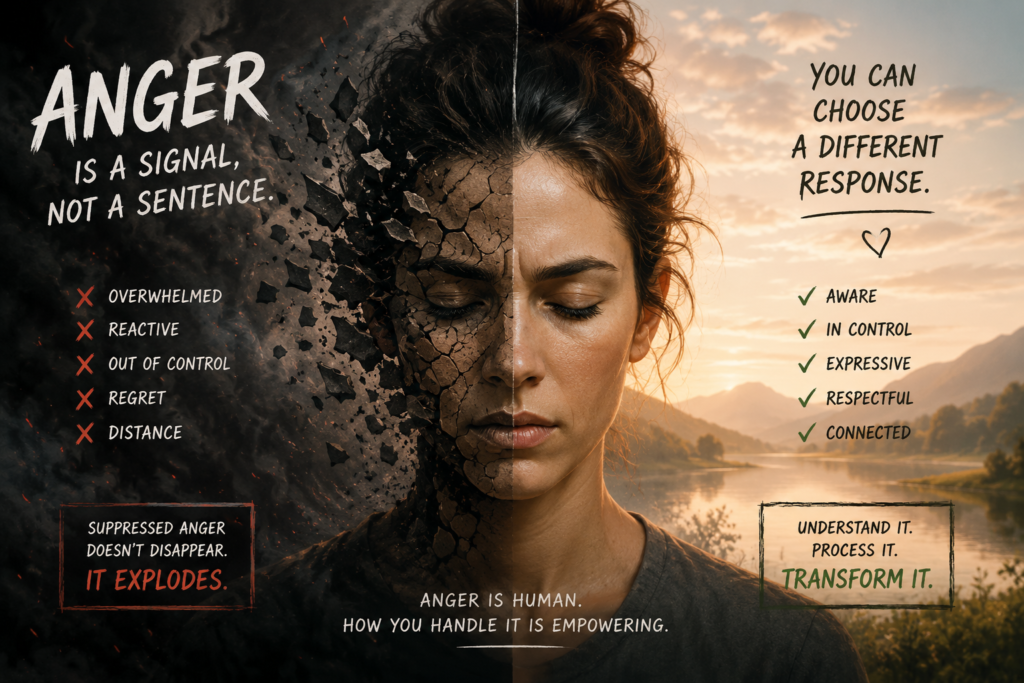
Ah, that worst thing within us, the worst of all emotions, the very worst of our nature. (For your convenience, an audio version of my blog is now available. Simply click the play button.)
My dear reader, I will be exploring emotions in the next few blogs. I hope that this series of writing will make you interact a little bit with me. I can use your input and what do you think, what would you change? Hopefully, I can learn from you as I wish that you will learn from me.
My years of studying the human psyche have taught me a few things. One of the most important is reading, and not just reading books, but also reading human behavior. So, let’s get into it a bit, shall we?
What is an emotion? Well, anger is a basic (primary) human emotion, like fear, sadness, joy, and disgust. It is a natural emotional response to perceived injustice, frustration, threat, or a violation of boundaries.
According to psychology, anger is often not a root emotion but a surface emotion. Underneath it, there is often hurt, fear, disappointment, or the feeling of being disrespected, among many other things.
Anger has been interpreted differently by many major psychologists. Here is what some of them had to say about it.

Sigmund Freud saw anger as part of our instinctual drives. He linked it to the death drive (Thanatos). According to him, if anger is not expressed, it can be repressed and turned inward, sometimes contributing to depression and other psychological conflicts.

Charles Darwin viewed anger as evolutionary and universal. Facial expressions of anger are biologically inherited (more on this later). According to him, anger helped humans survive through defense and dominance.

William James viewed emotions, including anger, as coming from bodily reactions. We feel anger because our body changes—our heart rate increases, our muscles tense. According to him, we are angry because our body reacts.
Anger is one of our oldest and most misunderstood emotions. But far from being a flaw, it actually has a purpose, and understanding it changes everything.
We’ve all been there. The sudden heat in your chest. The jaw that tightens without asking. In my part of the world, we have a saying that roughly translates to, “I saw red.” Literally, we do see red when we get angry or pissed off. Have you ever seen red?
The words rush to your mouth like a tide. Anger arrives uninvited, and for most of us, it leaves us feeling either ashamed or justified, but rarely enlightened.
But psychologists and neuroscientists have spent decades asking a more interesting question: not whether anger is good or bad, but what it actually is and what it’s trying to do.
“Anger is not the opposite of calm. It is information, urgent, embodied, and rarely wrong about what it’s pointing at.”
The Brain on Fire
When you feel anger, the amygdala, the brain’s threat-detection centre, fires rapidly, triggering a cascade of stress hormones, including adrenaline and cortisol. Your heart rate climbs. Blood flows to your muscles. Your prefrontal cortex, responsible for reasoning and impulse control, is partially overridden.
A few things happen at this moment, and the most common is the fight, freeze, or flight response (run for your life, run to safety, or run to Momma).
This is the famous “amygdala hijack,” a term coined by psychologist Daniel Goleman. In moments of intense anger, the thinking brain goes offline just when you need it most.
Have you ever experienced it? Let me know in the comment section. We might just all learn something.
The neuroscience at a glance
Amygdala: Detects threats and triggers the anger response in milliseconds, faster than conscious thought.
Hypothalamus: Activates the sympathetic nervous system, releasing adrenaline and preparing the body for action.
Prefrontal cortex: The “brakes” of the brain, its activity decreases during acute anger, reducing rational decision-making.
Anterior cingulate cortex: Helps regulate emotional responses and plays a role in how long anger lingers.
A feeling with a purpose
Evolutionary psychologists argue that anger evolved as a social enforcement mechanism. When we perceive that a boundary has been crossed, that we’ve been treated unfairly, disrespected, or harmed (wheather real or percived), anger signals to others that there is a cost to that behaviour.
Research by psychologist Jennifer Lerner suggests that anger is unique among negative emotions because it is approach-oriented. Fear makes us retreat. Disgust makes us recoil. Anger makes us move toward the source of the problem. That impulse, channeled well, underlies advocacy, justice-seeking, and meaningful social change.
The Myth of “Letting It Out”
Popular culture has long held that venting anger like punching a pillow (or shooting it, as it’s done in the movie Analyze This), screaming in your car, releases pressure like a valve. The science disagrees.
Studies by Brad Bushman at Ohio State University consistently show that cathartic venting tends to amplify aggression, not reduce it. The more you rehearse angry behaviour, the more fluent you become in it.
So, when you see yourself getting mad, stop. Take a deep breath and talk to someone whom you respect. Tell them how you’re feeling. Raising your voice or hitting someone or something will only increase your anger and could very possibly give you a heart attack. (And that, my dear reader, is not acceptable, who will then read my writing? A joke.)
What Does Work?
Cognitive reappraisal, reframing how you interpret a situation and what researchers call “anger cooling”: creating temporal distance between the trigger and the response.
The old advice to count to ten turns out to have neurological merit.
I know it’s not easy, but just as getting angry and dwelling on it intensifies that anger, so does relaxing, counting to ten, and taking long, slow breaths with even longer exhales. And I mean long exhales. For example, if your inhale is 5 seconds, exhale for 10.
Trust me, your mind and your heart will thank you in the future.
“Suppression buries anger. Venting feeds it. Understanding it is the only thing that actually metabolises it.”
When Anger Becomes Chronic
While acute anger is a normal human response, chronic anger—a state of persistent hostility and irritability—carries significant health risks.
And I know this firsthand. If you know me, you know that both I and my whole family have very short fuses. It took me 30 years to get myself under control, and if I can do it, so can you.
Longitudinal studies link trait anger to elevated cardiovascular risk, weakened immune function, and poorer mental health outcomes. The body pays a price for sustained threat arousal.
Interestingly, the direction matters too. Research distinguishes between anger that is expressed (outward), suppressed (turned inward), and controlled (processed constructively). Only the latter is consistently associated with well-being.
Listening to the signal
Perhaps the most useful reframe from psychology is this: anger is not a problem to be eliminated. It is a signal worth decoding. It almost always points to something that matters a value threatened, a need unmet, or a line crossed.
The work isn’t to silence it. The work is to get curious about what it’s actually saying and then decide, with a cooler head—and I really do mean a cooler head—what to do next.
Emphasis on the cooler head.
There is no single anger-management technique that works for everyone, but some of the most effective methods supported by psychological research are:
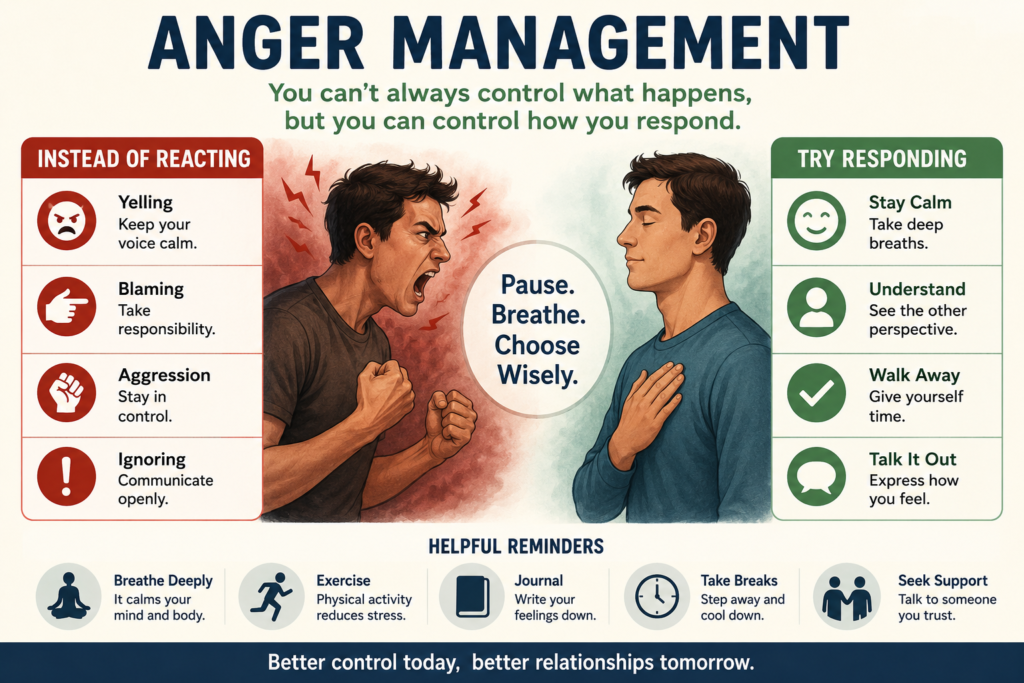
1. The Pause Technique
When you notice anger rising:
- Stop talking.
- Take 5–10 slow breaths.
- Delay your response for a few minutes if possible.
Even a short pause reduces the chance of saying or doing something you’ll regret.
2. Identify the Real Trigger
Ask yourself:
- What exactly am I angry about?
- Am I feeling hurt, rejected, embarrassed, or afraid underneath the anger?
Anger is often a “secondary emotion” that covers something deeper.
3. Cognitive Reframing (CBT)
Challenge automatic thoughts such as:
- “This is unbearable.”
- “They always do this.”
- “Nobody respects me.”
Replace them with:
- “This is frustrating, but I can handle it.”
- “One mistake doesn’t define the whole situation.”
4. Physical Release
Anger activates the body’s fight-or-flight system. Helpful outlets include:
- Walking
- Wheeling outdoors (for wheelchair users)
- Exercise
- Deep breathing
- Progressive muscle relaxation
5. Use “I” Statements
Instead of:
- “You never listen to me!”
Try:
- “I feel frustrated when I don’t feel heard.”
This reduces defensiveness and conflict.
6. Time-Out
If a discussion becomes heated:
- Take 20–30 minutes away from the situation.
- Return when calmer.
Research shows that physiological arousal can stay elevated for quite a while after becoming angry.
7. Mindfulness
Observe the anger without immediately acting on it:
- “I notice I’m feeling angry.”
- “My heart is racing.”
- “My shoulders are tense.”
This creates distance between the feeling and your reaction.
8. Ask: What Outcome Do I Want?
Before reacting:
- Do I want revenge?
- To be right?
- Or to solve the problem?
Focusing on the desired outcome often changes how you respond.
A Simple Formula
Notice → Pause → Breathe → Think → Respond
As a psychologist, you may appreciate William James’s insight:
“The greatest weapon against stress is our ability to choose one thought over another.”
Anger itself is not the enemy. It’s a normal emotion that signals something feels wrong. The goal is not to eliminate anger, but to express it in a way that helps rather than harms.
And we do that with a cool mind.
Think of it like this: if my head is going to explode, what good will come from that? What good will it do for my family and friends? Will I just look like a raging bull and have everyone laugh at me or avoid me? Or do I take some time off and deal with the problem when my head is cool?
Here’s a simple example. What’s the first thing you think of doing on a hot summer day? You go jump into a cold river or take a cold shower or something like that. You don’t go and jump into the fire.
So why, when we are angry, do we tend to jump into the fire?
Remember this: when your head is hot, don’t make decisions that your cool mind will have to live with.
Think about it.
After some thinking, I’ve decided to make this a shorter blog because this is a very complex issue. I’ll write about it in a few parts so that it’s easier to read.