I’ve been thinking about this for about 30 years. During my studies, I keep running into it as if someone or something is steering me that way. Why is it that the saying goes „I see the light at the end of the tunnel“ or „ The light overtook me“? Why is the light always associated with good? As you can probably gather, this blog won’t be psychology-based but rather philosophical. At a lecture by our rector, Prof. Dr. V. Vukotić, at one of our many debates, he said, „We have a philosopher here. „ So I hope I will be able to uphold that and not let him down; you, my dear reader, can be the judge of that.
Let’s examine light from different perspectives. Light has always been one of the richest philosophical symbols, both in a physical domain and as a metaphor for truth, knowledge, and being ( Thank you, Professor Vukotić, for encouraging us to read and use metaphors, please read his book „Simboli i metafore“, and all his other books they will become a part of your libraries and if you don’t have one start one today) In ancient philosophy (Greek thought) Heraclitus saw fire and light as the everchanging principle of cosmos. As the light changes, so should we.
( My thoughts: Light is the way we see.
And if we want to see — truly see — we have to be in the light.
I believe that most of us live in some form of darkness, unaware or half-awake.
We need to wake up.
We need to realize that we are all part of a community, and that helping others is what connects us to something greater.
But that help must be selfless.
Not the kind we talk about every day after we give it.
If you help — do it, then forget about it and move on.
That is the essence of true giving.
This kind of selfless action guides us into the light and makes our days brighter.
So do good. Be good. Help others.
In the end, the light will be with us — and nothing else will matter.)
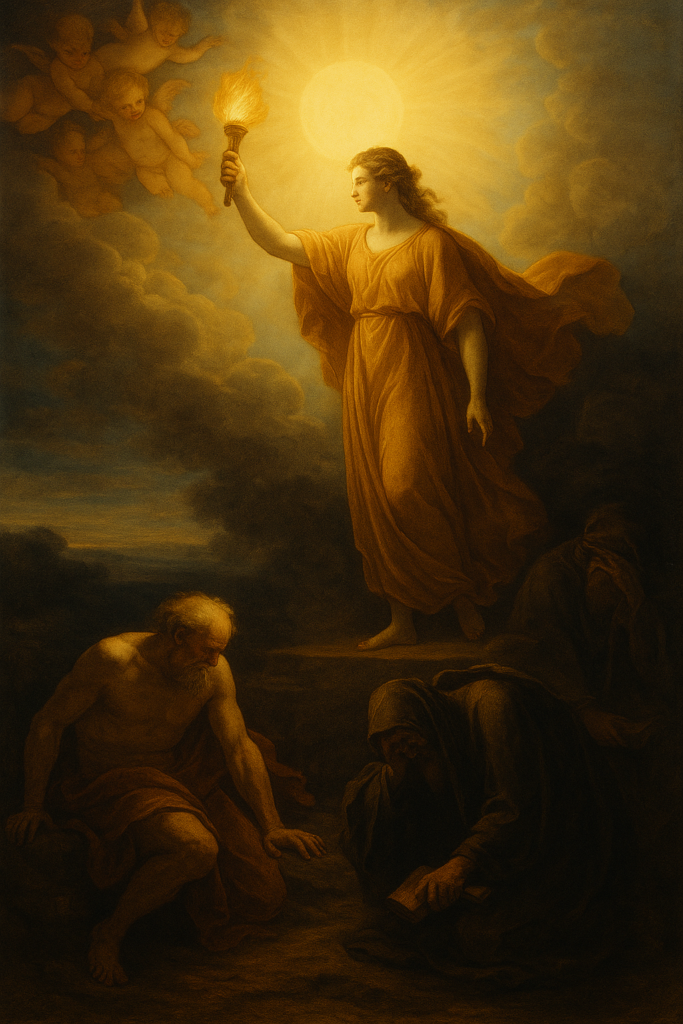
Plato compared the sun to good, just as the sun makes sight and life possible, his allegory of the cave presents light as enlightenment, pulling us from illusion toward truth ( hope you are familiar with Plato’s Cave— link)
Aristotle treated light more scientifically, as the actuality of the transparent medium, but still tied it to clarity and perception. In religious and mystical traditions, Christians thought, light often represented divine presence ( „ Let there be light.“), Christ being „ The light of the world“, in Islamic philosophy and Sufism, light ( Nur) symbolizes divine knowledge and the radiance of God; in Eastern tradition, light can symbolize enlightenment ( Buddhism), inner clarity ( Hinduism), or the eternal flame of consciousness.
In modern philosophy, Descartes and Enlightenment thinkers often used light as a metaphor for reason, clarity, and scientific progress — hence the “Age of Enlightenment.”
Kant described enlightenment as “emergence from self-imposed immaturity” — stepping into light by daring to think for oneself.
Phenomenology (Husserl, Heidegger, Merleau-Ponty): light is not just illumination but the condition for appearance itself; it makes beings manifest. Heidegger speaks of Lichtung (the clearing/lightening) — the open space in which Being reveals itself.
For Nietzsche, light sometimes symbolizes a harsh truth, in contrast to comforting illusions. Poets and philosophers alike see the light as both fragile and transcendent, a reminder of mortality but also of transcendence, hope, and renewal. In essence, light is the meeting point of physics and metaphysics: it is real, measurable, and physical, yet it irresistibly pulls us into metaphor — the symbol of knowledge, truth, freedom, and the divine.
I want to share some of my earlier writing, and maybe you will see why I chose this subject: „ Right now, in this very moment, you can be the spark that lights up someone’s dark day. I choose to be the beacon that shines in the darkest of all nights. I choose to be the star that guides you across the vast, uncertain sea. I am the ever-smiling person — and most importantly, I choose to be the LIGHT.” This is the end of my last blog, and now it’s the beginning, as I believe some ends can be the beginning and some beginnings can be the end. In some of my older writing and my thesis, I speak of NDE (Near-death experience) and being engulfed in light, a light not of this realm, but a light that was alive, that has a brightness not of this world, light that speaks to us and encourages healing, so let’s examine that a little.
Light as a Healing Modality: A Brief Review.
The healing power of light has been recognized across both scientific and cultural traditions. Contemporary research demonstrates that targeted forms of light exposure can regulate physiological processes, promote tissue recovery, and improve psychological well-being. One of the best-established applications is bright light therapy, commonly prescribed for seasonal affective disorder (SAD) and circadian rhythm disturbances. Controlled exposure to high-intensity light (10,000 lux) has been shown to alleviate depressive symptoms, improve sleep regulation, and stabilize mood (Golden et al., 2005; Lam et al., 2016). Similarly, light therapy is applied in neonatal medicine: blue light phototherapy reduces bilirubin levels in infants with jaundice (Bilirubin levels show how well your liver breaks down red blood cells and removes waste from the body.), thereby preventing neurological complications (Maisels & McDonagh, 2008).
Beyond psychiatry, low-level laser therapy (LLLT)—also referred to as photobiomodulation—has been investigated in wound healing, inflammation reduction, and pain management. Experimental studies suggest that red and near-infrared wavelengths can modulate mitochondrial function, enhancing tissue repair and reducing oxidative stress (Hamblin, 2017). In dermatology, blue light therapy has antibacterial properties that benefit acne treatment, while red light is studied for its potential in stimulating collagen and reducing photoaging (Avci et al., 2013).
Cautious use of ultraviolet (UV) light remains a mainstay in dermatological treatment of psoriasis, vitiligo, and eczema, though long-term risks of UV exposure require careful medical supervision (Parrish et al., 1981). More recently, preliminary research has suggested that narrow-band red light may support retinal health and could slow age-related macular degeneration (Shen et al., 2020).
Taken together, light serves not only as a metaphor for knowledge and spiritual renewal but also as an empirically supported therapeutic agent. While many mechanisms remain under investigation, light therapy occupies a unique intersection of psychological health, cellular biology, and cultural symbolism, bridging ancient intuitions with modern clinical practice.
Light as Healing — From Ancient Temples to Modern Clinics
The idea that light can heal is not just a modern scientific discovery — it is one of humanity’s oldest intuitions. Across cultures, sunlight and brightness were tied to life, vitality, and the renewal of the spirit.
In ancient Egypt, the god Ra, radiant in the sky, was both ruler and healer. Temples of healing were built to let in sunlight, and early medical papyri speak of its restorative powers. The Greeks, too, knew this well. Hippocrates, often called the father of medicine, prescribed heliotherapy — healing with the sun — for wounds, weakness, and lethargy. Apollo himself was worshipped as both the god of the Sun and of healing, a perfect symbol of how light and health were fused in the imagination of the ancients.
In the Vedic traditions of India, Surya, the Sun god, was invoked not just as cosmic order but as a force of healing. The daily sun salutations (Surya Namaskar) still practiced in yoga carry this dual meaning: physical strength and spiritual renewal. In China, the sunlight was seen as Yang energy — warming, life-giving, necessary for balance. To expose oneself to the morning rays was to invite vitality back into the body.
Even the scriptures of the Hebrews speak in this language: “The sun of righteousness shall rise with healing in its wings” (Malachi 4:2). Here, light is not just physics — it is divine presence, a force of restoration. Centuries later, Avicenna (Ibn Sina), in his Canon of Medicine, described the curative value of sunlight for melancholy and physical illness, anticipating what modern psychiatry now confirms in light therapy.
What we see across these traditions is more than folklore. It is a recurring insight: light renews, light heals, light restores order where darkness has broken it. And in this sense, our modern lamps for seasonal depression, our phototherapy units for jaundice, our red-light lasers for healing tissue — they are all echoes of this ancient truth.
Light has always been more than photons. It is energy, clarity, goodness, and health. From the temples of Ra to the wards of modern hospitals, the story is the same: when the light enters, healing begins. So, my dear reader, let the light enter, let it nourish you, let it guide you; only then will you be a full being, only then will you be able to lead others in the path of light. I quite often use a saying, ” let the sun be on your face and the wind in your back.”
Light Therapy in Psychiatry.
In psychiatry, light is not only a metaphor for hope and clarity — it is a prescribed treatment. The clinical term is bright light therapy, and it has become a first-line option for certain mood and sleep disorders.
The best-known use is in Seasonal Affective Disorder (SAD), a form of depression that emerges in autumn and winter when daylight hours shrink. Patients often report low energy, oversleeping, and a heavy mood that lifts when spring returns. Bright light therapy works by simulating the missing morning sun. Sitting for 20–30 minutes each day in front of a light box (usually 10,000 lux, much brighter than household lighting) can reset the circadian rhythm and increase serotonin and dopamine activity, improving mood and alertness.
Research has extended this approach beyond SAD. Clinical trials show benefits for nonseasonal major depressive disorder, especially when combined with antidepressant medication (Lam et al, 2016). Light therapy also supports treatment of circadian rhythm sleep–wake disorders, such as delayed sleep phase syndrome, by realigning the internal clock with external time cues.
The underlying mechanism ties back to biology: special cells in the retina detect light and send signals directly to the suprachiasmatic nucleus in the brain — the “master clock.” This regulates melatonin production, cortisol release, and ultimately mood and energy balance. In this way, light exposure is not cosmetic; it is a direct biological intervention.
What makes light therapy remarkable is its simplicity. It is non-invasive, relatively safe, and often free of the side effects associated with medication. Side effects, when they occur, are usually mild — eye strain, headache, or agitation if used too late in the evening. For many patients, though, it becomes part of a healing routine: a daily ritual of inviting light back into life.
In the history of psychiatry, this represents a fascinating convergence. Where ancient cultures spoke of the Sun as a healer of spirit, modern medicine has rediscovered that structured exposure to light truly can lift the darkness of depression.
So, where do I see the light in my life, and how do I think of it?
I believe that light is as important for us as air is, as food is, as water is. We need all of it to function right — the body, the mind, the spirit.
So I ask you, my dear reader — Are you getting enough light?
From Huberman’s podcast, I’ve learned many things, but one stood out to me: every morning, when you step outside, turn toward the sun.
It doesn’t matter if the sky is cloudy or bright — just turn.
If you can bear it, look at the sun for five to ten minutes. Even if you can’t keep your eyes open, close them and still face the light.
According to science, and as Huberman explains, there are sensors beneath our eyelids that activate even when our eyes are closed. They send a signal to the body — it’s daytime, get ready.
Our circadian clock wakes up, the system aligns, and the rhythm of the day begins.
Then, after roughly ten hours, the body remembers — it’s night. Time to rest.
Certain processes begin quietly within us, making us drowsy, helping us surrender to sleep. So maybe the question isn’t just where we see the light, but whether we allow it in.
Because light isn’t only a physical thing — it’s a reminder.
A reminder that life moves in cycles, that darkness always meets its dawn, and that renewal starts with something as simple as turning toward what gives us warmth.
Even on cloudy days, especially on those days, remember — the light is still there.
Now, here are my personal insights on this subject.
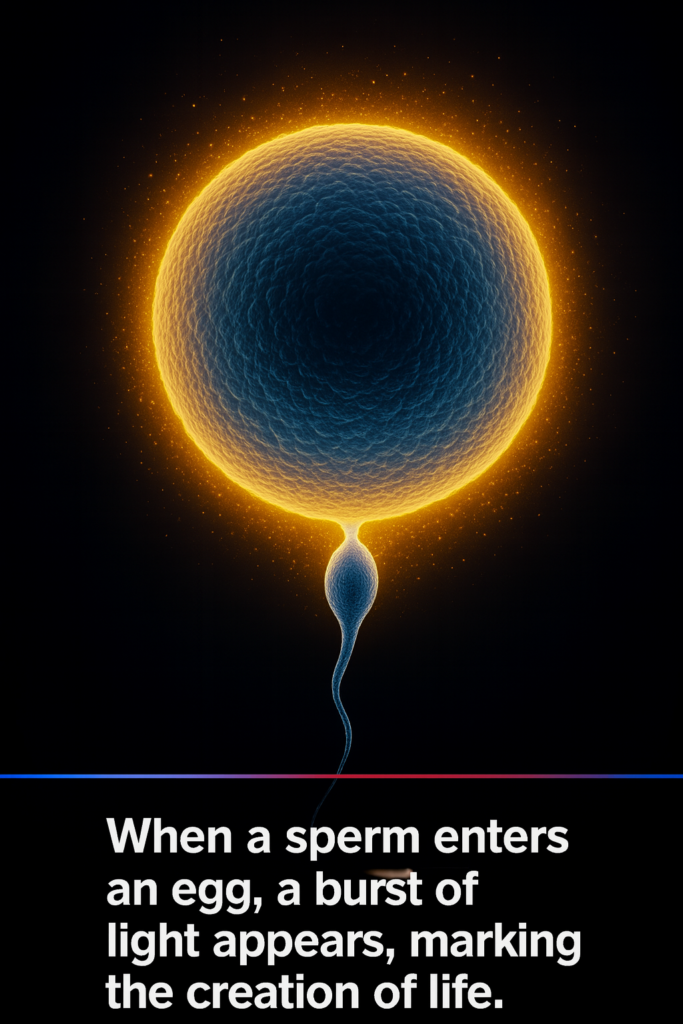
Before we are born, we know nothing but darkness — and then we come into this world, and the light feels so good, so right, so peaceful.
We are born into a world of both light and darkness. Most of us fear the dark and feel safer in the light. But is that a psychological thing?
After all, we know that bad things can happen both during the day and during the night.
So why do we associate good with light and bad with darkness?
Metaphorically, good is white and bad is black — but why?
Why, in the final moments of our being in this realm, are we enveloped by a bright light that feels so good, so peaceful, so complete?
During my research, I found that many people, just before taking their last breath, describe the room filling with light. This even happened to Carl Jung in 1945, during his near-death experience. And I’ve personally encountered at least four other cases of this same phenomenon — unexplained, yet undeniably real.
So, my dear reader — find time to enjoy the sun.
Find time to enjoy the company of your family and your dear people.
Because in the end, we all travel alone into the light.
My belief is that we will meet some souls from this realm again, but most we won’t.
Still, I send you the brightness of the sun — may you travel in light, may you find all that you need, and learn everything you came to this life to learn. And when the time comes, I will see you — here, and in the next realm.
“Death does not exist, and with that very knowledge, the fear of it disappears. And remember: no man who existed died. They turned into light and, as such, still exist. The secret is that these light particles return to their original state. Return to one of the previous energies. Christ and some others knew this secret. I was searching for how to preserve human energy. It is one of the forms of light. In the soul, sometimes equal to the supreme celestial light. ( N.Tesla possibly misattributed.)
Hi, this is the first time i read you since the time i had the big pleasure to know you in person and i love it. I Was needing light in this moment, greetings from your mexican carnal.
Thank you, you are and always will be my Carnal.